Showing posts with label animal kingdom lodge. Show all posts

Sunday, August 17, 2014

Thompson's Gazelle

Species: Thompson's Gazelle
Habitat: African Savanna
Status: Near Threatened
DAK Locale: Pembe/Sunset Savannas at AKL


Because it is one of the more common animals seen on the famous Serengeti, this gazelle is perhaps one of the most well known. The Thompson's gazelles, or tommies as Warden Wilson and many others call them, are small, light brown animals, with a black stripe along its side. Their horns are short and slender, though the males are distinctly longer than the females.

They are common prey for many of the areas predators including hyenas, leopards, pythons and crocodiles. Even eagles will take young. They are a staple of the cheetah's diet due to their relatively small size. Unlike bigger antelope, they don't typically stand their ground. Thankfully, they are fast, real fast: hitting 50 to 60 miles per hour. They also run in zigzag patterns in an effort to lose the hunter. A cheetah chasing a tommie is truly a sight to behold on a safari. The cheetah can actually run faster, but the zigzagging and better stamina evens the odds.


Tommies are mixed feeders. In the wet season, they eat mostly grass, but at dry times they tend to focus on browse for food. They tend to follow bigger herbivores like wildebeest and zebra. This is for two reasons. First, those animals are higher up and can see better over the tall grass to find lions and leopards. Secondly, they allow the bigger animals to mow down the taller grass to get at the shorter grass below.

The gazelle is territorial, at least the males. Female groups migrate through territories, and the male with the better food supplies, get more females into their area. If a bachelor comes into his territory, they will get chased off or have to fight. In keeping his territorial boundaries, males use their horns for marking and they also have a gland that they rub on trees and the like.


There are an estimated 550,000 Thompson's gazelles in the wild. It is likely the most numerous gazelle in all of East Africa. However, since the mid 1970s, its population has declined about 60%. For that reason, it is currently listed as Near Threatened. The decline is due mostly habitat destruction, fire, and road development.

Tuesday, June 24, 2014

Ankole

Species: Ankole
Habitat: Savanna
Status: Domestic
DAK Locale: Kilimanjaro Safari/Animal Kingdom Lodge


One of the few domestic animals in the Animal Kingdom is the Watsui cattle or Ankole. It is a breed of cattle native to the plains of Africa. It is very distinctive thanks to its huge set of horns. These horns can measure up to 8 feet across. They are used not only for defense but as a cooling mechanism as there are many blood vessels within them. Still, when watching them from you room at Kidani Village they are quite impressive.

Ankoles are well designed for their habitat. They can survive on poor quality forage. They also need small amounts of water. They live in herds for protection from the predators of the region like lions and hyenas. Females cows keep tabs on the calves while others eat. At night, they typically sleep huddled together.


It is unknown exactly when the breed was developed. However, they are clearly depicted in Egyptian hieroglyphics. They are even seen in ancient rock paintings found in the Sahara. Many tribes have relied on the breed over the centuries. However, it is probably most closely associated with the Tutsi of Rwanda. The animal was food, currency and even a status symbol within the tribe. The breed is known as the Cattle of Kings.

Tuesday, June 3, 2014

Roan Antelope

Species: Roan Antelope
Habitat: African savanna
Status: Least Concern
DAK Locale: Jambo House


The roan is a large savanna antelope found throughout virtually all of sub-Saharan Africa although more are found in the western and central portions of the continent. They are found in both woodland and grassland based savannas. It is found even in the forests. Typically, they eat mid length grasses.

They are named for their reddish brown color and are similar in appearance to the closely related sable antelope, which have a deeper red coloration. They have lighter tones on the belly with females being lighter. They have curved horns that are ringed with male horns being somewhat longer and they arch slightly backward.


The animal forms harems of one dominant male and several females with groups numbering 5 to 15 animals typically. The males commonly fight for dominance of the harems. These fights generally occur while both animals are on their knees. They do not have fixed territories but males attempt to keep other males away from the herd. When a calf is born, the mother will hide it in tall grass and stick close to the area.

Roans are not endangered although they are regionally extinct in portions of its historical range. This is due to both over hunting and deforestation. There are approximately 76,000 left in the wild.

Monday, May 19, 2014

Blue Crane

Species: Blue Crane
Habitat: Dry Grasslands of Southern Africa
Status: Vulnerable
DAK Locale: Kidani Village


The Blue crane is also known as the Stanley crane and is the national bird of South Africa. Among cranes, it is relatively small. It is also fairly obvious how it got its name. The bird is a light blue color which is darkest along the neck and back, where other areas are nearly white in coloration. Long wingtip feathers can touch the ground.

They generally live in dry upland areas that have access to wetlands. Feeding occurs almost exclusively in the drier areas of its range. Food is mostly insects but can include snails, frogs and small reptiles.  Of all the cranes, it is the most limited in distribution being found almost only in South Africa.


These birds are not overtly social. However, dominant males are at the top of the hierarchy. Males will dance to attract females, flinging objects and leaping into the air. Both males and females will incubate eggs, which usually number two in a clutch. The young are able to walk within two days and swim shortly thereafter.

It is believed there are about 26,000 birds left in the wild. It is no longer seen in parts of its historic range. The decline of the species is partly due to human hunting and habitat loss. It is currently listed as Vulnerable.

Waterbuck

Species: Waterbuck
Habitat: Savanna near water
Status: Least Concern
DAK Locale: Kidani Village


The waterbuck is a large antelope found in sub-Sahara Africa. Their coats are reddish brown as young adults and get progressively darker with age. This coloration is broken up by white on the chest and rump. Only males have horns, which can get long and spiral.

The animal prefers grasslands. Its name notwithstanding, the antelope does not live in water but near it. Its diet mostly consists of the long grasses that typically grow near rivers and swamps. It will go into the water to escape predators such as lions and hyenas. They are herd animals living in groups numbering as many 600. Males keep territories for food and mates.


Calves can be born throughout the year. Once born, the mother does it best to hide the calf from the numerous predators of the African plains. They will nurse for 6 to 8 months. Males, once weaned, begin to wander off and will create small bachelor herds until they can control their own territory. Young females tend to stay with their mother's herd. They are fully grown at about three years of age.

It is believed that there are about 200,000 of the animals left in this fairly wide range. In some areas, however, habitat loss and habitat fragmentation have put the waterbuck in decline.

Friday, May 16, 2014

Hartmann's Mountain Zebra

Species: Hartmann's Mountain Zebra
Habitat: Mountain slopes and open grasslands
Status: Vulnerable
DAK Locale: Animal Kingdom Lodge

The mountain zebra is found along the mountains of south western Africa. They feed on the grasses, shrubs and leaves from the more arid portions of the region. They do prefer higher elevations but will move down the slopes for grazing and have been known to seek shelter from the cold in forests.


Compared to plains zebra, the mountain variety live in much smaller groups. Typically, there is only one male, along with a up to five females and foals.  The male  will control the group until a bachelor overthrows him.  The other males live in their own separate bachelor-only groups.


Mountain zebras are divided amongst two subspecies, the Cape and the Hartmann's (which are found at the Animal Kingdom Lodge). The Hartmann's mountain zebra are found in the extreme southwestern part of Angola as well as western Namibia. They average 7 to 8.5 feet in height and can  weigh up to 800 pounds. This type of zebra have particularly strong hooves for climbing. Coloration is the same as other zebra except their bellies are white with one black stripe.


The mountain zebra is considered vulnerable. There are only about 7000 Hartmann's mountain zebras left in the wild. Hunting has been the biggest problem as locals are concerned about competition with domestic animals needing the same grasslands. Droughts have also hastened the decline of the species.

Monday, May 12, 2014

Common Wildebeest

Species: Common Wildebeest
Habitat: Plains and Dry Woodlands of Southern and Eastern Africa
Status: Least Concern
DAK Locale: Kilimanjaro Safari/Animal Kingdom Lodge

The common wildebeest is one of two species of wildebeest, with the other being the black wildebeest. Other names for the common variety include the gnu, the white bearded wildebeest and the blue wildebeest, the last of which stems from the slightly blue sheen of their short hairs. The animal has a muscular, front heavy appearance with a very pronounced muzzle and large horns. The legs, however, are thin for its body size.


The wildebeest is well known for its herds. There are large numbers of these animals in Africa, with over one million in the Serengeti alone. Very few people have not seen the herds traveling in vast numbers across the African plains in documentaries. Many predators such as lions and hyenas travel with the herds for food, while other species of antelope will mingle with the herd as a form of protection. Plain zebras are often found with wildebeest. The zebras tends to eat the heavy vegetation leaving the newer short grass for the gnu. In some parts of their range, the herds are significantly smaller numbering only a 30 or so animals as opposed to the thousands in the other parts of their range.


The massive herds are migratory in nature, moving from place to place after the rainy season has ended to go after wetter grasses. They will sometimes have to cross large, fast moving rivers. The herd will congregate at the edge of the river almost afraid to go in. And for good reason, not only is the river fast and treacherous but is often full of hungry Nile crocodiles. Eventually, one animal takes the plunge, and the rest soon follow. The weak and old often do not make it becoming crocodile food.

Males will become territorial and attempt to control a number of females for reproduction. Most of the mating occurs during the rainy season when things are "good." When young are born, they are ready to move. Most wildebeest calves are able to run within seven minutes of birth, which is necessary considering the amount of predators ready to take advantage of the weak. Young will stay close to their mothers for some time for protection. Interestingly, it appears in larger herds the survival rate of young is much higher.

Monday, February 17, 2014

West African Crowned Crane

Species: West African Crowned Crane
Habitat: Wetlands of the Savanna
Status: Endangered
DAK Locale: Animal Kingdom Lodge, Flights of Wonder


The West African Crowned Crane is considered by many as the most beautiful of all cranes, mostly due to his coloration and the plumage on top of its head which give it its name. This bird is also called the Black Crowned Crane and is closely related and similar in appearance to the East African Crowned Crane, also called the Grey Crowned Crane. The biggest difference is the Eastern species prefers wetter areas, while the Western bird is more at home in the drier savanna habitat.

These two species are the only cranes that nest in trees. All other cranes are ground nesters. Compared to other cranes, they are relatively small. They weigh only about 8 pounds and have a wingspan of approximately 6 feet. They eat a wide range of things from grasses to insects to small reptiles and mammals.


The West African Crowned is endangered. This has been due to habitat loss, pesticide use and overgrazing by domesticated animals. Also, it is not unheard of for the animal to be hunted for its signature plumage. The feathers are mostly dark on the body while the wing is predominately white. However, its head contains beautiful golden stiff feathers.

The bird is also well known for its breeding display. The ritual contains an elaborate display of dancing, bowing, and jumping. This ritual has been seen in pairs that do not mate. It is unclear as to the reason for this. Also, for those staying at the Animal Kingdom Lodge, you may occassionally hear its booming call which involves inflation of a neck sac. After eggs hatch, both parents tend to the young.

Tuesday, February 4, 2014

Red River Hogs

Species: Red River Hogs
Habitat: African Jungle
Status: Least Concerned / Not Endangered
DAK Locale: Animal Kingdom Lodge - Kidani Village (Sunset Savannah)

image copyright Disney
The first thing one notices about Red River Hogs is the color. Their rusty red color is very distinctive especially for members of the pig family. The hogs themselves are sometimes referred to as bushpigs. The black and white markings stand out amongst the red. Unlike other wild pigs, the tusks are nearly invisible.

Red River Hogs have a varied diet, eating everything from grasses and berries to insects and mollusks. They will use their tusks to root out tubers. They will even eat carrion. The hogs live in the African rain forest, and particularly stick close to rivers and swamps and are good swimmers. They are generally nocturnal (although in the peaceful environment of Kidani Village, these things don't always hold true).

The hogs live in small groups led by a dominant boar. The boar is accompanied by a group of females and their piglets. In total, the groups rarely exceed twenty in number. The piglets are distinctive for their striped patterns. It is believed this coloring makes it difficult to spot the animals in the broken light of the jungle underbrush. If a predator is around, the piglets will hide and stay as motionless as possible no matter how close the hunter gets.

At Walt Disney World, the red river hogs are found at Kidani Village at the Sunset Savannah which is can be seen near the Maji pool bar. They are in the same exhibits as the okapi. The hogs are generally out early in the day. Recently, the hogs here have been using a new mud wallow (a preferred way to cool down in the florida heat) near where can guests can watch.

Saturday, February 1, 2014

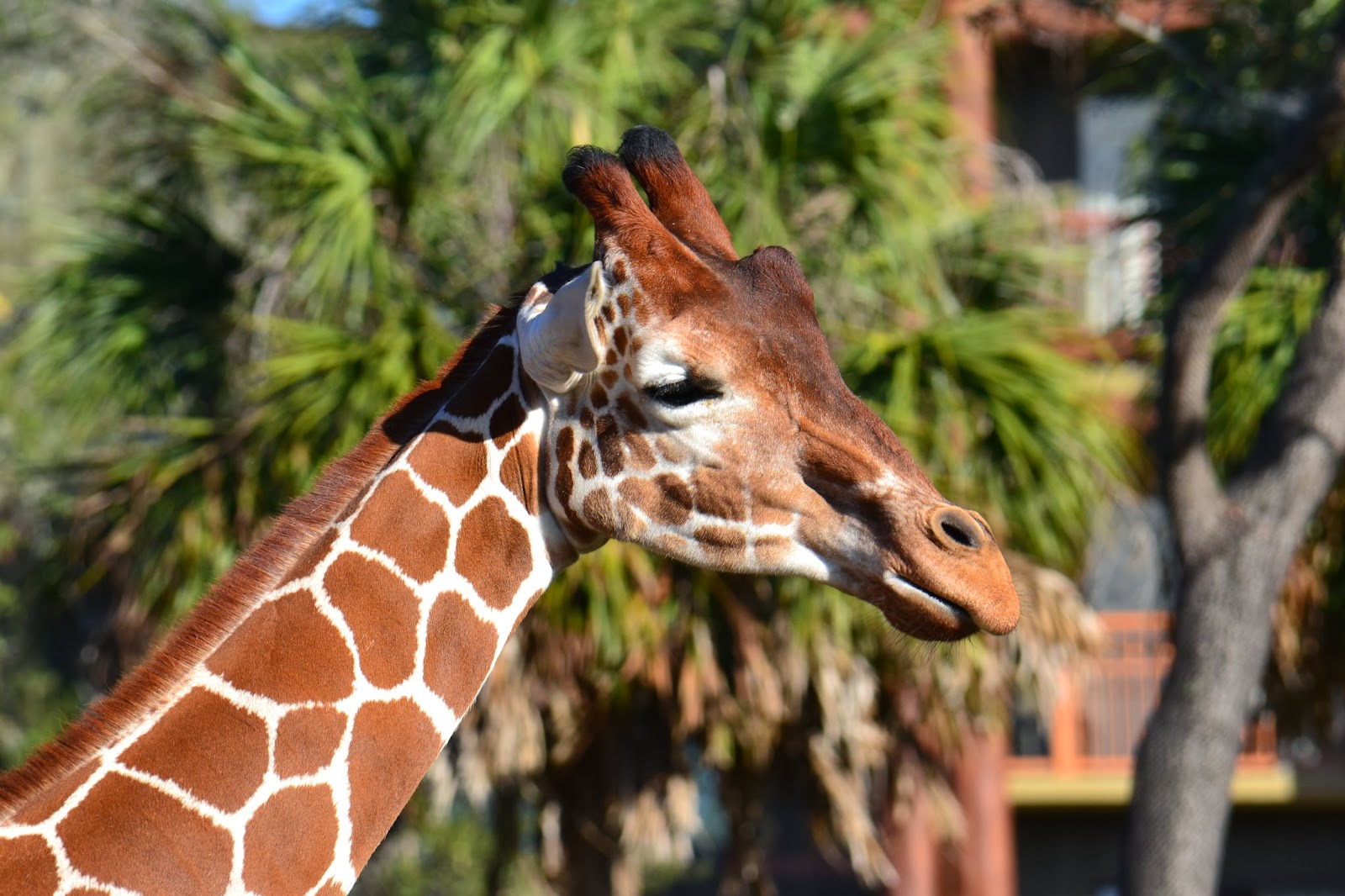
Reticulated Giraffe

Species: Reticulated Giraffe
Habitat: African Savannah
Status: Low Risk
DAK Location: Kilimanjaro Safari and Animal Kingdom Lodge


The giraffe is one of the most recognizable animals on the planet with its height, huge neck, big eyes, and color patterns. The neck, reaching 6 feet in length, has the same number of vertebrae that humans have, seven. Of course, a giraffe’s neck bones are much larger, stretching over 10 inches in length. At eighteen feet, the giraffe is the tallest of all land animals. The back legs only look smaller than the front giving the animal a odd gait. Still, it can run up to 45 mph. Also, look closely and you will see that both legs on the same side move together, a rarity in the animal kingdom.


Everything about the giraffe is super-sized. The tongue is over 20 inches to help with eating leaves in tall trees. An adult may eat up to 75 pounds of grass and leaves. Like cows, giraffes are ruminants. That is, they chew their food and then regurgitate the partially digested foliage to chew again as grass and leaves are nutrient poor and difficult to digest. The heart in an effort to pump blood far from it can be 2 feet wide and weigh 25 pounds. The lungs can hold 12 gallons of air. At about eight feet, it also has the largest tail of any land animal.


Giraffes have a gestation period of about 14 months, giving birth to a single calf. The calf drops six feet, head first, at birth. Within hours the calves can run but still are potential prey for lions, hyenas and wild dogs. Healthy adults, however, are generally not hunted by anything other than a particularly aggressive and/or desperate pride of lions as giraffes are huge and powerful. Giraffes are often seen necking, but its nothing like the human version. Instead, two necking giraffes are actually males in combat over females.


Giraffes are hunted for their pelts. It is believed that no two giraffes have the same color pattern. The distinctive coloration does provide camouflage particularly for calves hiding on the plains. They also suffer from habitat destruction. However, they are not considered endangered. There is an estimated 100,000 to 150,000 giraffes in Africa with the eastern and southern populations being the most stable.