Showing posts with label kilimanjaro safaris. Show all posts

Tuesday, December 30, 2014

Addax

Species: Addax
Habitat: Sahara Desert
Status: Critically Endangered
DAK Locale: Kilimanjaro Safari


Addax are hearty animals living in the nearly barren desert of northern Africa. They are well adapted to that environment. Their beautiful fur is light, reflecting the scorching sun. Their hooves are widely splayed to make it much easier to traverse the sandy landscape. They can survive without free water almost indefinitely, getting their water directly from the plant life they eat.

Pregnancy lasts nine months, usually with the mother giving birth to a single calf. At first, the newborns lie in the sparse vegetation of the desert (which is what the adult animals eat). The newborn will come out periodically only to nurse until it is big and strong enough to follow its mother. The herd is typically between 5 to 20 animals.


In the wild, the addax is virtually extinct. It is likely there are less than 200 animals in its former range, where in the 1800s it was quite plentiful. The massive decline is mostly due to over hunting. Leather from its hide was highly regarded. It is now considered critically endangered.

Tuesday, December 23, 2014

Nyala

Species: Nyala
Habitat:Lowlands of Southern Africa
Status: Least Concern
DAK Locale: Kilimanjaro Safari


The nyala is a common species of antelope in southeastern Africa. There it eats fruits, flowers, and trees. During the rainy season, the animal eats mostly grasses. They feed mostly at night or early in the morning. During the heat of the day, they will rest in the shaded thick bush.

Nyala are a good example of sexual dimorphism. That is, the males and females look much different. Females are a chestnut color while the male is a greyish, brown with spiraling horns. They are also much larger. They live in small groups but will mix with other species such as the impala and kudu for protection. The more animals there are together the more likely a hunter will be spotted. The major predators are, of course, hunting dogs, leopards and lions.

Currently, there appears to be about 35,000 nyala throughout their range. Fortunately, about three quarters of the population lies within national parks and reserves. Hunting, habitat loss and agriculture still pose a threat to the long term survival of the species but it is currently listed as Least Concern.

Thursday, October 16, 2014

Pink Backed Pelican

Species: Pink Backed Pelican
Habitat: African lakes, rivers, estuaries
Status: Least Concern
DAK Locale: Kilimanjaro Safari


The pink-backed pelican is actually rather small in the pelican world. Its name is derived from the pinkish hue on, not surprisingly, its back. Its also well known for its bouffant of feathers on top of its head. This grows only during breeding season.

Its found throughout Africa in its lakes, rivers and swamps. It will nest in colonies in trees, typically mangroves. One tree will sometimes have multiple nests close together. Pairs bond for one season.


This species is widespread throughout the continent, and as such is listed as of "Least Concern." However, in areas, the population is in trouble, especially in South Africa. It's also now extinct in Madagascar. As it lives near water, that can often mean conflict with humans, who also tend to live in those areas.

Wednesday, June 11, 2014

Hippopotamus

Species: Hippopotamus
Habitat: African rivers
Status: Vulnerable
DAK Locale: Kilimanjaro Safari & Pangani Forest


Hippopotamus is Greek for "river horse." As its name suggests, this animal spends a lot of time in the water. In fact, it is rare to see them out of the water at the Animal Kingdom. They tend to congregate in groups during the day, splitting up at night to eat. They follow trails to feeding grounds before heading back into the cool water before dawn. They secrete a red liquid from their pores that protects their skins from the sun, but they still tend to spend most of the daytime submerged. They are excellent swimmers and can remain underwater for five minutes. Their excrement is an important part aspect of aquatic plant life. However, their huge bulk can cause riverbank erosion leading some countries to begin culling programs.


Females become sexually mature around the age of 9, males at about 7. Females give birth to a single offspring (generally) and usually only become pregnant every other year. They are relatively long lived with hippos in captivity eclipsing 50 years of age. Hippos over 40, however, are somewhat rare in the wild.

As noted, hippos live in groups. Most being comprised of 10 to 15 animals of females and the young. However, there have been reports of herds in the range of 150 animals. Adult males tend to be solitary but that is not an absolute as small bachelor herds are known.


The hippo is listed as vulnerable. It has been hunted for meat, fat, hides and ivory teeth. In fact, the teeth's ivory does not yellow with age like an elephant's tusk making it more valuable on the black market. They also been hunted where they have damaged farmlands. Also, they are considered dangerous. It is believed that hippos may kill up to three thousand people a year. The species is wide ranging, however, being found in most areas of the continent.

Monday, June 9, 2014

Bontebok

Species: Bontebok
Habitat: Coastal grasslands of Western Africa
Status: Extinct in the wild/ Near Threatened
DAK Locale: Kilimanjaro Safari


The bontebok is extinct in the wild. At one time, thousands roamed the plains of South Africa, but the animal was extensively over hunted. So much so, there were less than 20 left in the world. However, a park started by farmers, Bontebok National park, was established in South Africa to protect the species. The animal's continued existence now appears secure, but they are no longer found in the wild. They are restricted solely to parks, game reserves and even farms.

The bontebok feed on the short grasses found in the savanna. They will spend the morning and evening hours grazing. During the midday heat, the animals become less active facing the sun and bobbing their heads. Males guard territories fiercely from competitors. Females, however, form small groups with their young. Groups of young males also form as they look for their own territory and herds of females.

The bontebok's body is compact. The neck is short with a long narrow face with white fur. Both sexes have similar horns. Females tend to be slimmer but there is little else to show a difference in gender. Their coats are a deep red. Young are first tan before changing colors. Breeding season generally occurs between January and March. The lambs are then born in early Fall.

Wednesday, May 28, 2014

Black Rhino

Species: Black Rhino
Habitat: African Savanna
Status: Critically Endangered
DAK Locale: Kilimanjaro Safari


So why are they called black rhinos? Well, white rhinos are called "white" due to a corruption of the word "wide," which describes its lip. Then to avoid confusion, they just called this species of rhino, black. The animals are similar in color. The white species, however, is about twice the size of the back kind.

Another difference between the two species of African rhino is, as noted, the lip. The wide lower top lip of the white species is replaced with a nimble hooked lip. This allows it pull up specific types of plants. Its known to eat over 200 species of vegetation. Typically, they feed in the early morning and late afternoon or early evening. The plants provide most of the moisture the animal needs, so it can go without drinking for days if it eats right.


Rhinos are notorious for having bad vision. Just looking at the animal you will notice how small its eyes are. This means the animal is quick to agitate even though it has excellent hearing and sense of smell. The black rhino is obviously fast, reaching speeds over 30 mph which makes it a dangerous animal in the savanna.


The black rhino is quite versatile, being found in many kinds of habitats including grasslands, semi-arid plains, dense brush and woodlands. However, it does prefer areas with a lot of cover to hide and eat. Historically, it was found throughout the lower half of the African continent. However, intense hunting pressures have splintered the population. In fact, it is thought that one subspecies. the western black rhino, is likely extinct. Unfortunately, the animal repopulates slowly giving birth only every two to five years. The total population is around 3,700 animals and as demand for the ivory of its horns continues to grow, the danger to all rhinos increases.

Thursday, May 22, 2014

Warthog

Species: Warthog
Habitat: African Plains
Status: Least Concern
DAK Locale: Kilimanjaro Safari


Warthogs are members of the wild pig family. They are found in the sub-Saharan grasslands of Africa. The name comes from the four large wart like protrusions on the top of their snout. These act a fat reserves and are used by males in fighting. They also have two pairs of tusks. These are used for digging, in defense, and fighting amongst themselves like the "warts."

The warthog is the only pig that has adapted to life on the plains. It eats grasses, roots, and berries as well as insects and carrion. The diet depends mostly on the climate. During the rainy season, they mostly graze. During leaner times of the year, the diet is much more "whatever they can find."


 Warthogs are common prey on the savanna. They are hunted by all the major predators: lions, hyena, wild dogs, leopards, cheetah and, of course, man. Females will defend their young against predators, even being known to give their own lives. However, the main method of defense is flight and the warthog is surprisingly fast. If cornered, the tusks are used as a last defense and can be very dangerous.

They live in groups called sounders and are very territorial. The groups are made up mostly of females with males living in territories they guard fiercely. The males have ranges that typically overlap several female sounders.

Warthogs are fairly numerous with estimated populations somewhere above 250,000. They are hunted for their tusks which are popular with the tourist trade. They are also susceptible to drought.

Saturday, May 17, 2014

Scimitar Horned Oryx

Species: Scimitar Horned Oryx    
Habitat: Arid plains of North Africa
Status: Extinct in the Wild
DAK Locale: Kilimanjaro Safaris

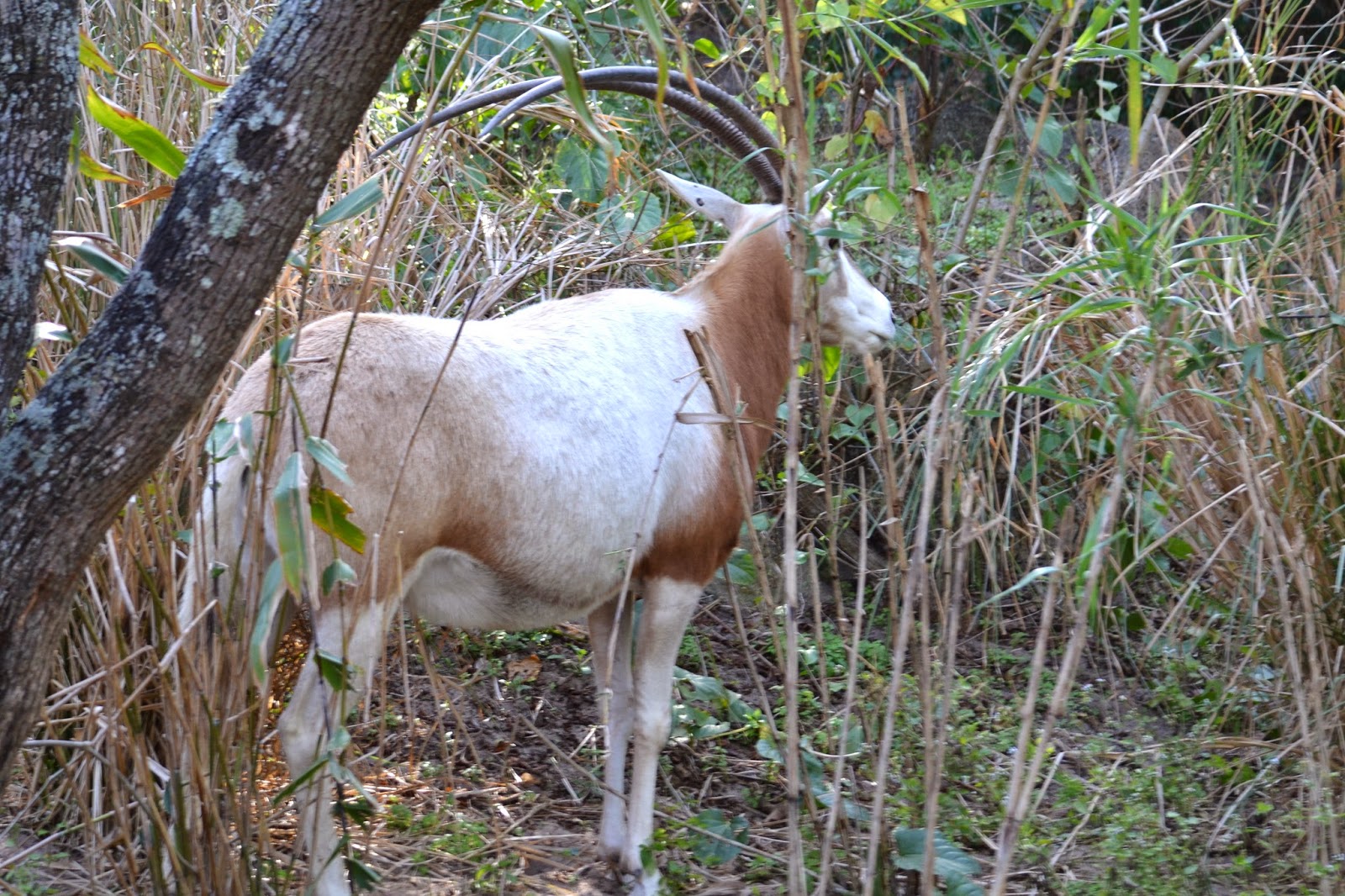
This oryx is actually extinct in the wild. They had once inhabited the deserts and semi-deserts of northern Africa. However, now is found only in game reserves in Morocco, Tunisia, and Senegal. It was hunted to near complete extinction for its beautiful horns, which are identical to each other. In profile, it can appear that the animal has one single horn. It is widely accepted that this animal is the source of the unicorn legend. This oryx was widely domesticated in Ancient Egypt and Rome.


They are perfectly adapted to living in the high temperatures and low moisture level of their habitat. They efficiently cool themselves in the heat in requiring less water. They can reach internal temperature's over 110 degrees before perspiring. They can tolerate temperature that would be lethal to most other antelope. They also feed almost exclusively in the early morning hours or at night to avoid activity at the height of the sun. Their coat, which is nearly all white with just some light tan markings, effectively reflects the sun's rays.


This species is very sociable. They travel in herds of up to 40 animals which are led by a dominant bull. However, the species did once migrate in herds of over a thousand animals. Herds will feed together and then rest under shrubs and trees together during the day. Although ,ales are bigger, both sexes have horns which are long and thin. They are also easily breakable which also could be the source of the legend of the unicorn.

Monday, May 12, 2014

Common Wildebeest

Species: Common Wildebeest
Habitat: Plains and Dry Woodlands of Southern and Eastern Africa
Status: Least Concern
DAK Locale: Kilimanjaro Safari/Animal Kingdom Lodge

The common wildebeest is one of two species of wildebeest, with the other being the black wildebeest. Other names for the common variety include the gnu, the white bearded wildebeest and the blue wildebeest, the last of which stems from the slightly blue sheen of their short hairs. The animal has a muscular, front heavy appearance with a very pronounced muzzle and large horns. The legs, however, are thin for its body size.


The wildebeest is well known for its herds. There are large numbers of these animals in Africa, with over one million in the Serengeti alone. Very few people have not seen the herds traveling in vast numbers across the African plains in documentaries. Many predators such as lions and hyenas travel with the herds for food, while other species of antelope will mingle with the herd as a form of protection. Plain zebras are often found with wildebeest. The zebras tends to eat the heavy vegetation leaving the newer short grass for the gnu. In some parts of their range, the herds are significantly smaller numbering only a 30 or so animals as opposed to the thousands in the other parts of their range.


The massive herds are migratory in nature, moving from place to place after the rainy season has ended to go after wetter grasses. They will sometimes have to cross large, fast moving rivers. The herd will congregate at the edge of the river almost afraid to go in. And for good reason, not only is the river fast and treacherous but is often full of hungry Nile crocodiles. Eventually, one animal takes the plunge, and the rest soon follow. The weak and old often do not make it becoming crocodile food.

Males will become territorial and attempt to control a number of females for reproduction. Most of the mating occurs during the rainy season when things are "good." When young are born, they are ready to move. Most wildebeest calves are able to run within seven minutes of birth, which is necessary considering the amount of predators ready to take advantage of the weak. Young will stay close to their mothers for some time for protection. Interestingly, it appears in larger herds the survival rate of young is much higher.

Tuesday, April 29, 2014

Springbok

Species: Springbok
Status: Least Concern
Habitat: Dry Plains of Southern Africa
DAK Locale: Kilimanjaro Safari


Springbok were a national symbol in South Africa and were often used as mascots for teams in that area. It's the symbol of South African airlines, it appears on the reverse side of the Krugerrand, and is the name of the national rugby team. Much of that has changed since the end of apartheid, but it still appears nationally in some forms. It is very plentiful, numbering about 2.5 million individuals in South Africa alone. The antelope is also plentiful in Namibia and Botswana.

In appearance, springboks look much like Thompson's gazelles, although slightly larger with more elaborately twisted horns. The animal is well known for one particular display called pronking. It is a display that apparently shows nervousness perhaps indicating to nearby predators that they have been spotted. It is also used by males to show strength. When pronking, the antelope leaps stiff-legged into the air.


Bachelor males and females form herds. These groups are separated by territorial males who control the groups of females in their area. Once weaned, females continue to stay in their mother's herd. Males join bachelor groups.

Springboks are a common prey for lions, leopards, and hyena. They are also hunted by cheetahs, jackals and caracals. The springbok is doing fairly well and is considered to have an expanding population.

Monday, February 17, 2014

Eland

Species: Eland
Habitat: Savanna
Status: Least Concerned
DAK Locale: Kilimanjaro Safari


The common eland is a species located in the open plains and savanna of southern Africa extending north into Ethiopia. They occupy a wide variety of habitats but prefer the semi-arid areas of their range. However, they do avoid dense forests. Their preferred diet is grasses, leaves and shrubs.

The common eland, found at Disney's Animal Kingdom, is the second largest species of antelope in the world, only behind its cousin the giant eland. It is sexually dimorphic, with males being significantly larger than females. Both males and females have horns.


Elands congregate in herds, with sometimes as many as 500 animals living together. The herd includes for the most part females and their young. Males are included as well but will wander off individually or in small bachelor herds. Often they can be found amongst other animals such as zebra and other species of antelope. They often use barks to communicate, but also use a variety of postures, as well. For example, if a predator is spotted the males will bark and pace back and forth attracting attention to himself as a warning to the rest of the herd.

Predators include lions, spotted hyenas, and wild dogs. The young are also vulnerable to cheetahs. Humans also hunt the animal for food and leather.

Common elands are not endangered. However, population numbers are decreasing due to habitat loss and poaching. Furthermore, locally populations are in bigger danger. For example, the animal is no longer found in Burundi or Angola. Elands are docile and are being domesticated for meat and milk in South Africa and Russia.

Sunday, February 2, 2014

Plains Zebra

Species: Plains Zebra
Habitat: African Plains
Status: Low risk
DAK Locale: Kilimanjaro Safari


The Plains zebra, also known as the common zebra, are, well, the most common species of zebra. They are located in the savannas of eastern and southern Africa. There they eat mostly grasses but will consume any available vegetation. Generally, they are smaller than other zebra species, the Mountain and Grevy's.

When one sees a zebra, the first thing one notices is, of course, the stripes. No one is quite sure why the animal has stripes. The most widely accepted theory is confusion. When a herd of striped zebras are running across the savanna, it may be difficult for a lion or hyena to distinguish when one animal begins and the other ends, making it difficult for the predator to get a "bead on" the prey. Another theory is that the stripes help regulate body temperature of the animal.


In the wild, zebras will mix freely with other hoofed stock such as wildebeests. The more animals that are together the more likely a lion will be spotted. A herd consists mostly of one male and numerous breeding females and their young. Here, at the Animal Kingdom, the herd is all female. The mares, or females, have a social structure within the group, with an alpha female leading the group. When a new female enters the herd, they are usually met with aggression and need protection from the male. Other harem-less males will attempt to steal females from herds leading to fighting.

Generally, the plains zebra population is stable world wide, although in some areas there has been a significant decline. There are threats from hunting for the hide and meat. In other areas, farming has encroached on the habitat. Recent civil wars in countries such as Rwanda and the Sudan, have local decreases.

Saturday, February 1, 2014

Reticulated Giraffe

Species: Reticulated Giraffe
Habitat: African Savannah
Status: Low Risk
DAK Location: Kilimanjaro Safari and Animal Kingdom Lodge


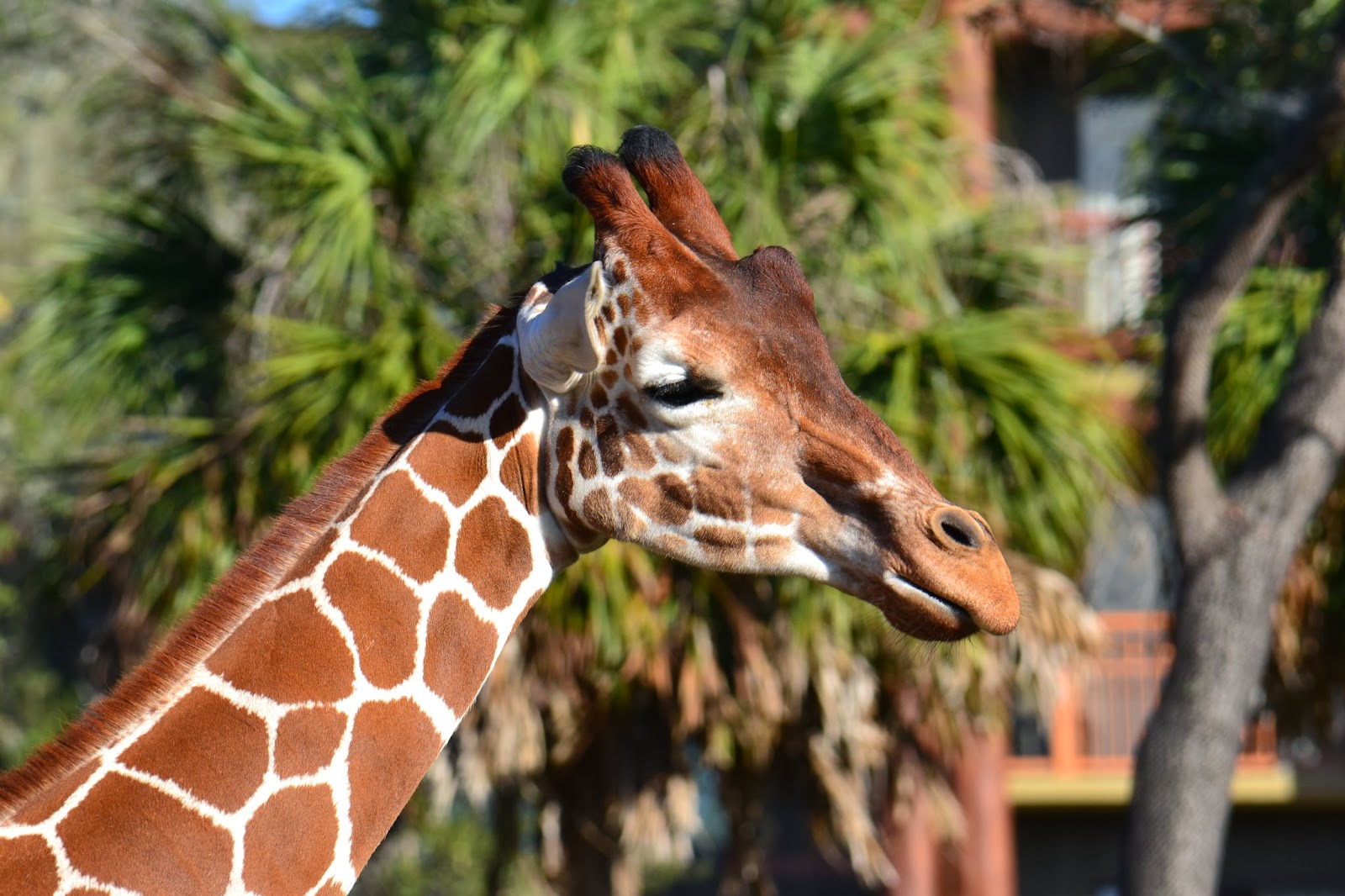
The giraffe is one of the most recognizable animals on the planet with its height, huge neck, big eyes, and color patterns. The neck, reaching 6 feet in length, has the same number of vertebrae that humans have, seven. Of course, a giraffe’s neck bones are much larger, stretching over 10 inches in length. At eighteen feet, the giraffe is the tallest of all land animals. The back legs only look smaller than the front giving the animal a odd gait. Still, it can run up to 45 mph. Also, look closely and you will see that both legs on the same side move together, a rarity in the animal kingdom.


Everything about the giraffe is super-sized. The tongue is over 20 inches to help with eating leaves in tall trees. An adult may eat up to 75 pounds of grass and leaves. Like cows, giraffes are ruminants. That is, they chew their food and then regurgitate the partially digested foliage to chew again as grass and leaves are nutrient poor and difficult to digest. The heart in an effort to pump blood far from it can be 2 feet wide and weigh 25 pounds. The lungs can hold 12 gallons of air. At about eight feet, it also has the largest tail of any land animal.


Giraffes have a gestation period of about 14 months, giving birth to a single calf. The calf drops six feet, head first, at birth. Within hours the calves can run but still are potential prey for lions, hyenas and wild dogs. Healthy adults, however, are generally not hunted by anything other than a particularly aggressive and/or desperate pride of lions as giraffes are huge and powerful. Giraffes are often seen necking, but its nothing like the human version. Instead, two necking giraffes are actually males in combat over females.


Giraffes are hunted for their pelts. It is believed that no two giraffes have the same color pattern. The distinctive coloration does provide camouflage particularly for calves hiding on the plains. They also suffer from habitat destruction. However, they are not considered endangered. There is an estimated 100,000 to 150,000 giraffes in Africa with the eastern and southern populations being the most stable.

Wednesday, January 29, 2014

White Rhinoceros


Species: White Rhinoceros
Habitat: Grasslands of Southern Africa
Status: Endangered
DAK Locale: Savannah East/Kilimanjaro Safari


There are several different species of rhino found in Asia and Africa. The White Rhino is found at the Kilimanjaro Safari Ride – Savannah East. You will notice that the white rhino is one of the largest land mammals weighing in at nearly 4500 lbs., which is larger than its cousin, the Black rhino, also found at the attraction. Males are significantly larger than females but both sexes have the signature two horns. The white rhino got its name from a misinterpretation of an Afrikaans word for “wide”, referring to the white rhino’s broad lip.


The rhino is famous on the safari circuit for being nearsighted, even occasionally charging jeeps that they mistake for other rhinos. The black rhino, the culprit behind these “attacks”, is the more aggressive species. The white rhino is much more docile and approachable. To see in front of themselves, they must look one eye at a time. A rhino’s olfactory passage is larger than their brains.


Rhinos are either grazers or browsers. As a grazer, the white rhino eats grasses and the like. They are often accompanied by oxpeckers, a bird that eats the insects off their skin. This symbiotic relationship is beneficial for both critters. Also, the rhino lacks sweat glands. This requires them to spend a lot of time in mud wallows to stay out of the heat and cool off.


The rhino reproduces at a very slow rate, a complicating factor in the efforts to save the species. White rhino females reproduce every 3 to 4 years giving birth to (generally) only one young after a 17 month gestation period. Rhinos across the world have been hunted to near extinction. Their horns are used for ceremonial daggers and is ground up into a powder for an aphrodisiac in China. Poachers often hack up off the horn leaving the rest of the carcass on the savannah. Currently, there are probably less than 15,000 white rhinos. The population worldwide has decreased about 90% since 1970 due to habitat loss and poaching. There are 2 populations of the white rhino, the northern and southern. Unfortunately, the northern subspecies found in the Congo nows numbers a mere 4 animals virtually guaranteeing its eventual extinction.

African Elephant


Species: African Elephant
Habitat: Sub-Sahara Africa
Status: Endangered
DAK Locale: Kilimanjaro Safari


Elephants are one of the most popular zoo animals and the largest land mammal on Earth. These highly intelligent behemoths are unusual and impressive in appearance yet are seemingly gentle. Of course, what the public does not realize is that elephants kill or injure more zookeepers than any other animal. This stems from their incredible strength more than any real aggression. Plus, elephants require more hands-on care by the keepers than just about any other type of critter. The massive African bulls are the most aggressive and can weigh up to 6 tons, with females topping the scales at about 4 tons.


One of the most frequently asked questions about elephants is whats the difference between the African and Asian types. The Africans are much larger with significantly bigger ears. There is a smaller forest type of the African species but at Disney's Animal Kingdom we see the savannah kind. Elephants in general use their large ears as fans, but they also contain numerous blood vessels close to the skin to help the cooling process. The distinctive trunk is used for breathing, smelling and as an extra limb which can grab food with its nimble end. The animals have 4 useful teeth which are huge and grooved. These can only be replaced 6 times in their lives and many an old animal dies from starvation after losing its last set. This usually occurs around the 70th year. The famous tusks (unlike Asian elephants, both males and females have tusks in Africa) are actually incisor teeth.


The most endearing quality of the elephants is its family life, at least among the females. These groups are matriarchal, meaning a group is lead by the dominant female. The rest of the herd is comprised of other females and the young. Bulls are driven away once they reach puberty and live on thier own or in a bachelor herd until they get their own group. Males join herds only briefly to breed. Females reach maturity at about 14 years of age and give birth after a 22 month gestational period, that is, their pregancy lasts nearly 2 years. No wonder the boys take off (Just kidding). The calf is about 250 pounds at birth and will suckle for up to 2 years. A female gives birth every 4 years or so and usually has 3 or 4 young with her at any given time.

The family members stay in constant contact with one another. In fact, at the Bronx Zoo, it was recently discovered that the 2 separate groups were consistently calling one another at other ends of the 250+ acre park. These calls were too low for the human ear to pick up. However, we can sometimes hear elephants call one another in a low gargling noise.


The famed legend of the elephant graveyard comes from the behavior of elephants greiving over the loss of a family member. Elephants have been known to bury their dead with leaves and twigs- a behavior only shared by man. The herd will sometimes spend days at the corpse of a dead elephant often touching and caressing the body. This was first recorded by the Roman writer, Pliny. In fact, it has been shown that elephants once back at the site of a long dead family member may caress the bones left behind. This may also account for its legendary memory in folklore.

Elephants eat a lot. The diet consists of a large variety of grasses, foliage, fruit and twigs. They eat all day and night. They can digest as much as 500 pounds of vegetation a day and can drink as much as 40 gallons of water at a time. Despite this, man has long domesticated the animals. The first domesticated elephants appear in accounts in India around 5500 BC. In fact, elephants have always played an important role in that culture's unique mythology.


As we all know, the elephant is highly endangered. Hunting has been banned but, as Little Red can tell you, poaching is still a major problem, especially with the price of ivory being so high. Gamekeepers are now heavily armed in order to protect the herds from even heavier armed poachers. In Kenya alone, the population dropped from 150,000 to 30,000 in 10 years. During the 1980s, it is estimated that nearly half of Africa's 1.2 million elephants were killed almost exclusively by poachers.